

This page provides guidance for professionals about decision making processes and the conducting of reviews to learn from serious cases or incidents. It also provides links to good practice guides and templates.
RELATED GUIDANCE
SAR Referral Form (opens in Word)
Amendment – This updated policy was signed off by the SAR Oversight Subgroup in October 2025.
CONTENTS
1. Introduction
The role of the Trafford Safeguarding Adults Board (SAB) is to support individuals and families to stay safe, well and live free from abuse and neglect. One of the ways the partnership does this is through multi-agency processes designed to gather and share learning from cases to continuously improve single agency practice and multi-agency working.
This guidance sets out Trafford’s approach for conducting Safeguarding Adult Reviews (SARs) and has been designed to incorporate the statutory criteria set out in the Care Act (2014), as well as drawing on best practice from the Social Care Institute for Excellence (SCIE) Quality Markers, and the Greater Manchester Safeguarding Adult Review Guidance. This SAR Policy and Practice Guidance applies to all partners on the Trafford Safeguarding Adults Partnership.
The purpose of the guidance is to:
- Set out the local referral and decision-making arrangements for SARs and discretionary learning reviews.
- Ensure there is a consistent approach to the consideration of referrals and the conducting of reviews.
- Clarify the different review and assurance processes, how the process will be managed by Trafford SAB and how recommendations will be shared with relevant subgroups, multi-agency partnerships and agencies.
- Set out the governance arrangements for implementing multi-agency review recommendations and measuring the impact of any changes.
The table below explains the language used to describe the local stages of the decision-making process following a SAR referral.
| Stage | Description | |
| 1 | Referral process | Understand and recognise cases that are appropriate to be considered for a safeguarding adult review |
| 2 | Quality assurance checks | Consider the referral to ensure it is appropriate, meets the relevant information requirements and gather partner information for the 3 statutory leads to decide if the referral can progress to the next stage |
| 3 | Multi-agency screening | Gather relevant single agency chronologies for the multi-agency partnership to decide if the referral meets the eligibility criteria for a mandatory SAR or other review and if so, scope the Key Lines Of Enquiry (KLOE) for the review |
| 4 | Multi-agency review | If the case is eligible, commission a safeguarding adult review or conduct an alternative review process or learning event |
| 5 | Action planning | Once the review has been signed off, multi-agency action plans are designed to share the learning and implement the review recommendations |
| 6 | Review and impact | Once actions have been completed, agencies come together to understand how the learning has made a difference and improved the quality of services and safeguarding arrangements in Trafford |
2. Purpose and Criteria for Safeguarding Adults Reviews
2.1 Purpose
The purpose of a Safeguarding Adult Review (SAR) is to assess the effectiveness of local multi-agency safeguarding arrangements and establish what lessons can be learnt to improve systems to safeguard adults at risk of experiencing harm or abuse. Reviews are designed to build a culture of openness, transparency and learning across partners to help prevent or reduce the risk of recurrence of similar incidents. Understanding systemic issues, whether and how policy, services and practice need to change is critical to ensure local systems across Trafford remain dynamic and self-improving.
Importantly, reviews are not conducted to apportion blame, to progress a complaint or to hold individuals or services to account. There are other processes for this purpose, including coronial inquests, employment law, formal complaint processes, disciplinary procedures, professional regulation and criminal proceedings. These processes may be carried out alongside SARs or at a different point in time.
2.2 Statutory framework
The Care Act (2014) sets out the legislative framework for conducting a Safeguarding Adult Review (SAR) where either:
- an adult with care and support needs has died and it is known or suspected that the death resulted from abuse or neglect or
- an adult with care and support needs is alive, but it is known or suspected that they have experienced serious abuse or neglect
- and there is reasonable cause for concern about how agencies worked together to safeguard the adult.
The Care Act defines an adult as someone aged 18 years or older. In the context of SARs, something can be considered serious abuse or neglect where, for example the individual is likely to have died but for an intervention, has suffered permanent harm or has reduced capacity or quality of life (whether because of physical or psychological effects) as a result of the abuse or neglect.
Cases meeting the above criteria require a mandatory review. The Care Act also states that Safeguarding Adult Boards (SABs) are free to arrange a SAR for an adult in its area with care and support needs in any situation where partners feel there could be learning. These cases are called Discretionary SARs. Both mandatory and discretionary SARs are covered under Section 44 of the Care Act.
In addition to the statutory framework, the Social Care Institute for Excellence (SCIE) has produced a set of quality markers to support a consistent approach to the commissioning, conducting and quality assurance of SARs. The quality markers provide a helpful checklist.
2.3 Information sharing
In relation to Safeguarding Adult Reviews, the Care Act provides the legal framework for requesting and sharing information held by partners about an individual and any associated professional practice. The data sharing requirements for Statutory Adult Reviews applies to all agencies and information should be provided within the timescale requested.
The collection of information will follow the safeguarding principle of proportionality. Requests for data about others associated with the adult at the centre of the review will only be made after having first considered their human rights, including their right to a private life. Information about associated individuals will only be requested where this is essential in order to carry out the statutory requirements for the review and is considered to be in the public interest. Where access to health records is required, requests can apply to all records of NHS commissioned care whether provided under the NHS or in the independent or voluntary sector.
Further guidance can be found in Trafford SAB privacy notice/information sharing protocol. The Trafford SAB Business Unit will ensure that information shared is GDPR compliant before being securely circulated with review papers to partners.
When responding to requests for information agencies should:
- identify how much information to share
- ensure names of professionals are redacted
- ensure information is shared securely through the password protected documents
- follow best practice where the adult is alive and inform them that their information has been shared (Under Section 44, consent to the sharing of their information is not required) as long as doing so does not create or increase the risk of harm
- record all information sharing decisions and reasons in line with organisational procedures.
In the case of any disagreement or failure to comply with a formal information request, the Trafford SAB Business Manager or Lead Reviewer will raise the issue with the Trafford SAB Independent Chair who will seek to resolve this with the strategic safeguarding lead for the agency concerned. If a prompt resolution cannot be found, the issue will be escalated to the Trafford SAB Executive for formal action.
3. Safeguarding Referral and Decision Making Process
3.1 Making a referral
SAR Referrals can be made by any statutory or voluntary agency, Safeguarding Adult Board in another area, or other interested parties such as HM Coroner.
It is the responsibility of all partner agencies to ensure that they have routine processes in place to actively identify cases that are appropriate for a SAR referral. Referrals for a SAR should be considered in addition to, or as a follow on to any separate single agency Serious Incident Reviews that may be conducted by the organisation. Agencies should make a referral for a SAR where there are reasonable grounds to consider that the Care Act criteria will be met. Agencies should ensure that staff know about SARs, their purpose and function, and how to make a referral through their organisation and the Trafford SAB Business Unit are always happy to attend Team Meetings to raise awareness.
Referrers should consider the following:
- Where possible please complete and submit the referral within 5 working days of becoming aware that the case may meet the criteria for a SAR.
- Referrals should be made by completing the Trafford SAB SAR Referral Form (opens in Word).
- The referral should set out how each component of the statutory criteria is met, including the suspected types/s of abuse or neglect.
- It is imperative that information is provided about the characteristics of an individual’s identity e.g. sexual orientation, gender, ethnicity or disability and any specific concerns where these characteristics have been a factor to the individual being exposed to serious abuse or neglect.
- The referral must be quality assured and signed off by the Service Manager or agency safeguarding Lead before being submitted to the Trafford SAB Business Unit via the following secure email address: [email protected]
On receipt of the referral an acknowledgement will be sent to the referrer by the Trafford SAB Business Unit.
3.2 Quality assurance checks
The Business Unit will conduct a series of pre-screening checks as part of the Quality Assurance Process within 7 working days of the referral. The checks will:
- Identify any immediate actions required to safeguard the adult who has been referred or any other adults with care and support needs associated with the case and communicate this to the relevant agency or request assurance.
- Identify inappropriate referrals and contacting the referrer to redirect where appropriate (e.g. section 42 Safeguarding referral).
- Ensure the referral has all the key information and enough detail to understand the concern/s.
- Request any additional information that is required from the referrer or other key agencies for clarification.
- Where the adult has died, request information about the cause of death from HM Coroner and any intention to conduct an inquest.
- Request information from partners to identify any ongoing single agency reviews, complaint cases, LeDeR referrals or DHRs / (DARDRs).
- Ensure there is reasonable cause to feel that the case may meet eligibility for a review under the Care Act.
Once all the information has been gathered, the BU completes the QA Checklist Template and sets up a virtual meeting for the three statutory leads to review the referral and QA information. These meetings are Chaired by the BU Manager as an independent role, to provide advice about the content and application of Care Act Guidance, and to secure a unanimous decision.
Where the decision is to progress the referral through a multi-agency screening, the three statutory leads will be asked to agree the scoping period for review.
The Quality Assurance Checks will recommend one of the following four options:
- Take the referral forward to the multi-agency SAR Screening.
- Request alternative action or assurance from relevant agencies.
- Request additional information and for the referral to be resubmitted.
- Close the referral and feedback the decision to the referrer.
The outcome of the quality assurance checks will be recorded on the QA Decision Document.
Where the adult has died and the intention is to screen for a SAR, the Trafford SAB Business Unit will notify HM Coroner.
3.3 Multi-agency screening
To progress the Multi-agency SAR screening, the Trafford sAB Business Unit will send out a request for all agencies to complete and return a Single Agency Chronology Template detailing their involvement with the adult during the agreed timescales leading up to the safeguarding incident or their death. The chronology should provide information in line with the stated review period (see Section 3.2, Quality assurance checks) or any information outside of the review period that may be of significance to the KLOE or learning for the review. Where agencies are unsure, they should discuss the level of detail with the BU before completing the chronology.
Partners will have 13 working days to return the information to the BU or submit a Nil Return.
The Trafford SAB Business Unit will also send out invitations for partners to attend a Multi-agency SAR Screening Meeting. Depending on the nature of the review, the membership of the SAR Panel meeting may include representatives from the following agencies:
- Adult Social Care
- Health (Commissioning/ICB)
- Greater Manchester Police
- Greater Manchester Mental Health
- Primary Care
- Acute Hospital Trusts
- North West Ambulance Service
- Drug and Alcohol Services
- Probation Service
- Housing Provider
- Homelessness services
- Voluntary Sector Representative
- Domestic Abuse Services
- Care and Residential Provider Services
- Greater Manchester Fire and Rescue Services
Other relevant agencies likely to be known to the individual.
The Trafford SAB Business Unit will share the single agency information as a combined chronology and timeline send this out with the referral form to panel members at least 4 working days before the panel meeting. Delays submitting single agency chronologies will mean the Screening Panel may need to be delayed.
3.4 SAR decision flowchart
The Multi-agency SAR screening meeting will review the chronology to identify:
- Any care and support needs, as defined within the Care Act, including individual vulnerabilities, past trauma, care leaver and informal caring relationships.
- How agencies worked together to manage risk and/or safeguard the individual in the months leading up to their death or the safeguarding incident.
- Intersectionality (how the social characteristics and cultural background of an adult and their family may have impacted on their daily lived experiences including life chances, vulnerability and/or discrimination).
- How the social characteristics and cultural background of an adult and their family may have impacted on professional decision making and their access to services.
- Any systematic barriers that may have prevented the individual accessing the right care and support at the right time.
Following the sharing of information, partners will use the SAR Decision Flowchart (in Appendix 1) to decide if the referral meets the threshold for a SAR and to record the rationale for the decision.
If there is a difference of opinion the decision flow chart will be used to try and resolve any disputes by identifying the majority view. Each agency will have one vote. Where the decision cannot be resolved within the meeting the case will be escalated to the Executive Leads for a final decision.
The SAR Screening Meeting will decide one of the following:
- The case is eligible for a Mandatory SAR
- The case is eligible for a Mandatory SAR but there is identical learning already being reviewed so a partners have recommended a more proportionate response
- The case is not eligible, but partners want to commission a Discretionary SAR
- The case is not eligible, but partners want to conduct an alternative review such as a learning event leading to the production of a policy, briefing, or learning resource.
- A request for single agency or multi-agency assurance.
- Refer the case for a LeDeR or Domestic Homicide Review (DHR) / Domestic Abuse Related Death Review (DARDR).
- No further action.
Regardless of whether the decision is made to conduct a Mandatory or Discretionary review, both count as a SAR. Where it is decided that the criteria for a SAR have been met, the panel will be asked to:
- agree the draft Key Lines of Enquiry (KLOE) and the questions they feel should be addressed by the SAR process
- scope and timeframe for the review
- agree the type of review to be commissioned
- consider the involvement of family and friends
The minutes and outcome of the SAR Screening meeting will be recorded on the SAR Decision Template and shared with the Trafford SAB Independent Chair for scrutiny. The referrer will also be informed of the SAR decision.
Where the adult has died and the case is going forward for a SAR, The Trafford SAB Business Unit will notify HM Coroner.
4. Conducting the Safeguarding Adult Review
4.1 Summary of the three stage process
Whilst the number of meetings needed to conduct a SAR may vary depending on the type of review the panel agrees, the SAR Review will in most instances progress through the following three stage process.
| Stage 1:
Planning |
SAR Panel to agree the type of review based on the nature of the circumstances, existing learning, and extent of the expert or legal advice required.
SAR Panel to agree the scope, timeline, terms of reference and key lines of enquiry for the review. Where the review requires an Independent Reviewer, this information forms the basis for inviting Expressions of Interest (EOI) from Reviewers. Where appropriate, Trafford SAB Business Unit commissions an Independent Reviewer and agrees the timescales for panel meeting and planned sign off date with the Reviewer. Membership of the SAR Review Panel is agreed based on the scope and nature of the case. This should include safeguarding leads from services known to the individual as well as others who should have been involved in support. Panel members consider how best to involve the adult, or where they have died, their family, carers, and friends. Panel members consider involving a Care Act Advocate. Trafford SAB Business Unit to identify and establish links to any other relevant processes such as Crown Prosecution or HM Coroner. Independent Reviewer and Review Panel members meet to determine what information is required to conduct the review. |
| Stage 2: Review | Where appropriate, the contributions of front-line staff will be involved in practitioner sessions to help identify practice and systemic issues.
Independent Reviewer to meet with the adult if they are alive, or their family, carers or friends where possible. Review Panel to receive and scrutinise information and draft reports. Panel to maintain links with interested parties and parallel investigations. Independent Reviewer and Review Panel agree a framework for the report and SMART (specific, Measurable, Achievable, Relevant and Time-bound) recommendations. Allow time for the adult, family or friends to read the draft report and reflect on the findings before it is signed off and where appropriate, work with the family to identify a pseudonym for the report. Contributing agencies to confirm the accuracy of the facts and interpretation of their involvement with their own organisations before finalising the report. Contributing agencies will need to confirm who has endorsed the accuracy of the report on behalf of their organisation. |
| Stage 3:
Sign off |
Chair/lead reviewer agrees the final draft report and recommendations with the SAR Panel
The SAR Panel meet separately to draft the Action Plan designed to implement the learning The final report, draft Action Plan and publication schedule are presented to the Trafford SAB Executive meeting for final consideration and sign off. Where the review is joint with the Children’s Services or a DHR /DARDR, the final draft will be presented to a joint meeting. The final report is published on the Trafford SAB website (unless the Executive has concerns where the adult is still alive or implications for surviving family). The final report is shared with the national SAR library database. The actions from the action plan are added to the Trafford SAB SAR Tracker and implementation monitored by the SAR Oversight Subgroup. At least 6 months after implementation of the Action Plans, the QA and Performance Subgroup review the impact of the recommendations and changes. A summary of the review, learning, subsequent changes, and impact are reported in the Trafford SAB Annual Report. |
4.2 Conducting the review – the detail
4.2.1 Values and principles that underpin the review process
Trafford’s approach to reviewing single agency practice and multi-agency working is underpinned by the following principles identified by local partners:
- Person Centred: The individual and their family, carers or friends (where able) will be invited and supported to contribute purposefully to reviews. We will support them to understand how they are going to be involved and their expectations managed appropriately and sensitively.
- Think Whole Family and Whole Household: The review process will reflect a ‘think family’ approach and encompass issues and concerns for the whole family network within the review, key lines of enquiry and resulting learning. This includes a whole household approach to encompass other people living in, or visiting the household who are not relatives.
- Participative and Collaborative – staff from all levels should participate and feel they are making a difference. A consultative approach provides richer narrative, encourages awareness of quality issues and ownership of the findings. It encourages the view that measuring quality and impact is something done with and by staff rather than done to them.
- Enable Change: All reviews will provide learning back into the system to improve the way services are provided, not simply describe or challenge it and the process should illuminate barriers and enablers to practice.
- Embedding Learning: Individual agencies will be responsible for identifying and addressing issues early, pre-emptively analysing and learning from reviews.
- Proportionate: The approach taken to reviews should be proportionate according to the scale and level of complexity of the issues being examined. The methodology to capture the learning will be decided on a case by case basis.
- Timely Response: All reviews should be completed in a timely manner (ideally within 3 to 4 months and no longer than 6 months) unless there is a reason for a longer period, e.g. on-going criminal proceedings, needing to work at the pace of the individual or family involved.
4.2.2 Agreeing the review type
Following the decision to commission a SAR the multi-agency SAR Panel will be responsible for initiating the review and agreeing the most appropriate and proportionate review methodology.
When deciding the type of review, a synthesis of learning from previous SARs should be used to develop a proportionate approach that builds on any repeat learning already within the system rather than starting afresh. Choosing the review type should consider:
- Is the case complex, involving multiple abuse types and/ or victims?
- Is the case complex, involving a range of children’s and adults’ services or covering more than one borough?
- Is significant public interest in the review anticipated?
- Is large-scale staff/ family involvement wanted/ appropriate?
- Are any criminal proceedings ongoing that staff are witnesses in, and could the SAR methodology impact on them?
- Is the type of review being suggested proportionate to the scale and level of complexity of the issues being examined?
- What is the quickest and simplest way to achieve the learning?
- Is a more appreciative approach required to review good practice?
- Do we have similar learning currently or previously reviewed that we could combine?
- Are trained lead reviewers available in-house or nationally for the method selected?
- Can value for money be demonstrated?
The SAR Panel will agree the key lines of enquiry, proposed methodology and appropriate people to be part of the case review panel.
4.2.3 Appointing the lead reviewer
Where the chosen review methodology requires an Independent Reviewer, Expressions of Interest (EOI) will be invited by the Trafford SAB Business Unit. The EOI will be promoted through the Trafford SAB registered list of reviewers and via the national SAB Network distribution list. Normally an EOI will allow 3 weeks for responses.
The Trafford SAB Business Unit will review the EOI to ensure the reviewer has the appropriate skills, knowledge, and experience to lead the case under review. Where possible 3 EOI will be sought for consideration by the Trafford SAB Business Unit and Chair of the SAR Panel.
4.2.3 SAR planning
Once the reviewer has been appointed the Trafford SAB Business Unit will:
- meet with the reviewer to plan the schedule of panel meetings and agree the agencies to be invited to take part in the review.
- send out notifications to inform agencies about the review and to request agencies to nominate a senior member of staff to join the Review Panel.
- arrange for the independent reviewer to meet with the agreed panel members, ensuring that representatives have had no immediate line management of the case under review.
The SAR Panel will normally be Chaired by the Independent Reviewer.
The methodology for mandatory and discretionary SARs can vairy significantly but it is expected that the SAR Panel will support the lead reviewer in their analysis of existing and new key lines of enquiry. The SAR Panel also provides local context and challenge to the analysis of professional practice and the identification of learning. Where single agency or engagement in the process is not of the expected standard then the lead reviewer/or Chair of the SAR Panel will raise this with the Business Unit and Trafford SAB Chair.
The SAR Panel will set their own meeting schedule and timings appropriate to the conduct of the review and its methodology but consider any parallel reviews or planned dates for a coronial inquest. Face-to-face meetings will be held where practicable.
The Trafford SAB Business Unit is responsible for ensuring reviews are completed to a high standard and in a timely manner.
4.2.5 Involvement of family, friends and carers
In Trafford we consider it good practice to ‘think family’ and involve relevant family, carers and friends in a meaningful way. Reviews should, where appropriate, be informed by family members knowledge and experiences relevant to the period under review. There should be a common commitment amongst professionals about the involvement of families and carers and the professional responsible for facilitating their involvement should be considered on a case by case basis.
Consideration must be given to any access or communication needs and contact with family should be made through existing trusted professionals where possible, the Independent Reviewer or where appropriate the Care Act Advocate.
The lead contact must ensure that the sharing of information is proportionate and relevant and the focus for involvement is about capturing individual and family experiences of services, what they think could have been done differently, and if they feel the suggested changes seem right to them.
To help encourage involvement and understanding of the process, the Trafford SAB Business Unit will share its SAR Guidance for Families and Friends when making contact which will include information about the Lead Reviewer.
Where the adult who is the focus of the review is alive, consent to engage their family or friends must be sought.
4.2.6 Professional engagement
It is imperative that senior leads who are nominated to be part of the SAR Panel prioritise attendance at the Panel meetings to ensure continuity. Where appropriate, the views of front-line professionals who were known to or involved in the support of the individual should also be captured to inform the learning. The final draft of the report should also be shared for information with practitioners to show that their views have been captured and how their views have made a difference.
Trafford SAB recognises that it can upsetting and in some cases re traumatising, for practitioners who were closely involved with an individual prior to their death, to take part in the review. The Trafford SAB Business Unit will contact relevant service managers to identify the appropriate practitioner/s to be involved in the review, and to ensure that appropriate support will be offered by line managers during the process. The Trafford SAB Business Unit will also provide clear guidelines to practitioners explaining what to expect and ensuring that the event offers a safe and supportive space, that does not tolerate a culture of blame within the review.
4.2.6 Finalising the report
All agencies involved in the review will be given the opportunity to confirm the accuracy of facts and interpretation of their involvement in the report. It is essential that contributing agencies complete any internal/single agency consultation and sign-off of the draft report before the report is considered by the Executive. Any significant changes requested after this date will be subject to the agreement of the Independent Reviewer and may significantly delay the process.
The Trafford SAB Business Unit will ensure that the final version of the report is shared with all the agencies and services taking part in the review.
4.2.7 Producing the action plan
It is the responsibility of the SAR Panel to produce the draft Action Plan and publication schedule for final sign off by the Executive. The meeting to produce the Action Plan should consider involving wider representatives from specialist services and partnerships to ensure the actions are appropriate, achievable, and owned by relevant agencies/bodies.
4.2.8 Record keeping
All the records collected as part of the review will be held securely and confidentially for an appropriate period in line with the Trafford SAB Data Sharing Agreement and UK GDPR regulations. The SAR report will remain on the Trafford SAB website for a period of two years before being archived.
5. Publication and Dissemination
On completion of the SAR, a report cover page, the final report, action plan and publication schedule will be presented to the Trafford SAB Executive to sign off the statutory review.
The Executive will:
- Consider issues of publication and safety where the adult is still alive, or where the adult has died but the circumstances mean that they, their family and/or professionals can be identified from the report.
- Consider any potential media interest in publication and media statement required by Trafford SAB.
- Consider any actions requiring immediate change to safeguard adults at risk of abuse and neglect highlighted by the review.
- Agree how the learning themes will be taken forward including who is responsible for their implementation.
- Publish a summary of the learning from statutory reviews in the Trafford SAB annual report alongside an account of the actions taken and the impact of actions on improving the safeguarding system/practice.
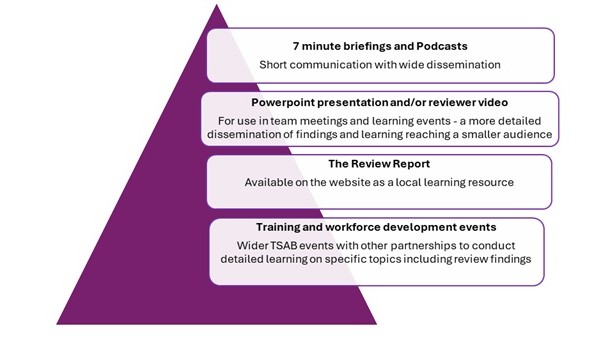
Dissemination of learning from reviews is designed to maximise awareness and facilitate two-way discussions about the issue raised. Dissemination will include the following:
6. Implementation and Review
6.1 Action plan implementation
The SAR Oversight Subgroup is responsible for overseeing implementation of the SAR Action Plans. Once agreed by the Executive, the actions will be added to the SAR Tracker and progress reviewed as a standing agenda item at each quarterly meeting.
The SAR Subgroup will be responsible for ensuring effective links with the Learning and Development, Prevention, Practice and QA and Performance Subgroups so that workforce development and learning is undertaken, and the impact is measured and shared.
6.2 Performance management
As part of the quarterly highlight reports submitted to the Executive, the Trafford SAB Business Unit will provide data about the number and timeliness of reviews, as well as details of progress against any outstanding actions. Learning from all the individual reviews will be regularly analysed under key Learning themes to identify repeat trends and ensure continuous improvement.
6.3 Reviewing impact
Following the implementation of the Action Plans, members of QA and Performance Subgroup will evaluate the impact of actions taken to address the learning themes and SAR recommendations. Partners will be asked if they feel assured that a similar case could not happen again and if not, consider what further actions are needed. The outcome of these review meetings will be shared at the Trafford SAB Subgroup Chairs meetings and where there are concerns that further action is needed, with the Executive.
These findings will form part of the Trafford SAB Annual Report.
If you require any further information about this resource or the work of the Trafford Safeguarding Adults Board please visit our website Trafford Safeguarding Adults Board or email us at [email protected].
7. Useful Resources
Care Act 2014: Section 44 Eligibility for conducting Safeguarding Adult Reviews
Developing effective Safeguarding Adult Review learning events (Research in Practice)
Safeguarding Adult Review Quality Markers (SCIE)
National Safeguarding Adult Review Library (SCIE)
Published Safeguarding Adult Reviews opens in the Trafford Safeguarding Adults Board website.
Appendix 1 – SAR Screening Flowchart
SAR Decision Flowchart (opens as a PDF)
Appendix 2 – Safeguarding Values and Principles
Trafford Safeguarding Adults Board employs the six safeguarding principles in its approach to its safeguarding responsibilities.
| Principle | Description | Outcome for Adult at Risk |
| Empowerment | Presumption of person led decisions and informed consent. | “I am asked what I want as the outcomes from the safeguarding process and these directly inform what happens.” |
| Prevention | It is better to take action before harm occurs. | “I receive clear and simple information about what abuse is, how to recognise the signs and what I can do to seek help.” |
| Proportionality | Proportionate and least intrusive response appropriate to the risk presented. | “I am sure that the professionals will work for my best interests, as I see them and will only get involved as much as needed.”
“I understand the role of everyone in my life.” |
| Protection | Support and representation for those in greatest need. | “I get help and support to report abuse. I get help to take part in the safeguarding process to the extent to which I want and to which I am able” |
| Trafford SAB | Local solutions through services working with their communities. Communities have a part to play in preventing, detecting and reporting neglect and abuse. | “I know that staff treat any personal and sensitive information in confidence, only sharing what is helpful and necessary. I am confident that professionals will work together to get the best result for me.” |
| Accountability | Accountability and transparency in delivering safeguarding. | “I understand the role of everyone in my life.” |
By adopting these principles, the Trafford SAB is able to demonstrate its commitment to Making Safeguarding Personal (MSP) and the SAR Panel will ensure that the review conclusions reflect the voice of the person wherever possible.