

CQC Quality Statement
Theme 4 – Leadership: Learning, improvement and innovation
We statement
We focus on continuous learning, innovation and improvement across our organisation and the local system. We encourage creative ways of delivering equality of experience, outcome and quality of life for people. We actively contribute to safe, effective practice and research.
This page contains an accessible formatted version of the Supervision Policy. Alternatively you can view the Supervision Policy (PDF version).
November 2025 – This policy has been updated throughout.
CONTENTS
1. Introduction
“Supervision is the process by which one worker is given responsibility by the organisation to work with another worker, in order to meet certain organisational, professional and personal objectives, which together promote the best outcome for service users.” (Morrison, Staff Supervision in Social Care, 2005).
Social Care supervision encompasses both personal supervision and case supervision and both aspects need to be given consideration during every supervision session.
The Knowledge and Skills Statement for social workers in adult services (KSS 8) sets out the expected standard, from an organisational and individual’s perspective:
“Social workers must have access to regular, good quality supervision and understand its importance in providing advice and support. They should know how and when to seek advice from a range of sources including named supervisors, senior social workers and other professionals.”
Social Work England Professional Standard 4.2 states that as a social worker, I will:
“Use supervision and feedback to critically reflect on, and identify my learning needs, including how I use research and evidence to inform my practice”.
The Standards for employers of social workers in England 2020 (Local Government Association) state that:
“Supervision should ‘challenge and foster an inquisitive approach to social work’ and ‘supervisors’ practice and skills should adhere to the KSS for practice supervisors in adult social care”.
This policy outlines how Trafford Adult Social Care will enable supervisors and supervisees to meet the above recommended definitions and standards.
2. Purpose and Scope
2.1 Purpose
The purpose of this Supervision Policy is to provide staff within Adult Social Care with a common framework and clear expectations for supervision so that they can deliver positive outcomes for the communities within which they work. It is designed to ensure consistent supervision practice across the service, to guarantee minimum supervisory standards and to help all involved be clear about what to expect from supervision.
The purpose of supervision is to focus on developing and motivating staff for the benefit of the individual, the organisation as a whole and the adults with whom they work.
2.2 Scope
This Supervision Policy needs to be operated alongside other Trafford Council policies and procedures such as; Induction, probationary reviews, performance appraisals (EPIC check in, opens in Trafford Council intranet ), identifying staff training needs, managing absence, health and safety and progression.
Supervision is an important right and benefit for all those working in Adult Social Care. It supports staff to critically analyse, reflect on their practice and to manage the emotional impact of their work, which will naturally result in better outcomes for service users.
Managers, supervisors and practitioners (supervisees) are jointly responsible for ensuring that supervision meets the requirements as set out in this policy.
It is important that staff employed by Adult Social Care:
- understand what is expected of them;
- have the skills, knowledge, behaviours, values and attitudes necessary to carry out their role;
- are fully supported in their work and managed effectively.
Supervision is one of the ways in which these outcomes can be achieved. All staff have a right to expect supervision, which is appropriate to their needs and that of the organisation. This policy sets out how staff can expect to be supervised and provides supervisors with the key elements needed to supervise staff effectively.
It is intended that supervisees receive a Trafford appraisal in the form of an EPIC check at least every 6 months. The issues and goals discussed at this time, should be reviewed and discussed within their monthly supervision.
3. Roles and Responsibilities
3.1 Senior managers
It is senior managers’ responsibility to:
- be familiar with this supervision policy and guidelines;
- monitor and evaluate the standard of supervision across the service;
- ensure that supervisors and supervisees are fulfilling their responsibilities and that positive outcomes are being achieved.
3.2 Supervisor
The supervisor may be the line manager or another designated person. For example, experienced social workers (Level 3) may be asked to supervise the non-registered social care workforce.
It is the supervisor’s responsibility to be familiar with this policy and to undertake supervision training to provide the supervisee with all the aspects of supervision: management, development, mediation and support (see Section 3.4 Theoretical framework for supervision).
In this way the supervisor will:
- be accessible to the supervisee to ensure that their cases are discussed, reflected upon, analysed and plans and action are agreed;
- prepare for supervision by reading any relevant documents or case notes beforehand, to ensure familiarity with complex cases;
- ensure the supervisee understands the wider aspects of their role and responsibilities and is developing the knowledge, skills, learning and experience to support them in exercising their role;
- quality assure the supervisee’s work to assess performance and provide constructive feedback, recognising positive interventions and responding to unmet professional needs;
- address any poor performance issues and implement action plans, support, mentoring and referring to the Managing Capability policy, as required;
- monitor absence from work and explore any issues arising from this in line with the Attendance Management policy;
- respond sensitively and appropriately to non-work-related issues that may affect the supervisee’s well-being and work performance, offering options within Trafford’s well-being policies to support the development of emotional resilience;
- record the supervision on Trafford’s supervision record template and send to the supervisee within 5 working days;
- promote Trafford’s Equality Policy Statement by challenging inequality, discrimination and disadvantage both in service delivery and employment practice, following the appropriate policy as required.
3.3 Supervisee
It is the supervisee’s responsibility to:
- make supervision a priority;
- prepare for supervision by:
- considering particular aspects of their allocated cases they need to gain the supervisor’s advice or guidance on;
- preparing a case reflection using a case reflection template (see example in Appendix 3) and one other case, to discuss in detail;
- identifying development needs;
- any other items for the agenda;
- show commitment to professional development to promote their knowledge, skills and expertise (a template to complete CPD is available, see Appendix 9);
- inform the supervisor of any issues arising within their work, team, service area and seek guidance when necessary;
- accept positive feedback and learn from constructive feedback, which may identify areas for development, taking the necessary action to improve performance;
- promote anti discriminatory and anti-racist practice, and respond appropriately to any issues regarding equality, diversity and inclusion for themselves, their colleagues where appropriate, and for service users.
3.4 Theoretical framework for supervision
This policy, procedure and guidance draws on the work of Tony Morrison, ‘Staff Supervision in Social Care’ (2005). He outlines a model which uses Kolb’s Experiential Learning Cycle, as the basis for his 4x4x4 model.
The model has three fundamental elements, each consisting of four parts.
The four stakeholders in supervision
- service users;
- staff;
- the organisation;
- partner organisations.
The four functions of supervision
- management – competent accountable performance;
- development – discussing and creating opportunities for CPD;
- support – offering personal support and discussing wellbeing;
- mediation – engaging the individual with the organisation.
The four elements of the supervisory cycle
- experience;
- reflection;
- analysis;
- action.
(Click on image below to make it larger)
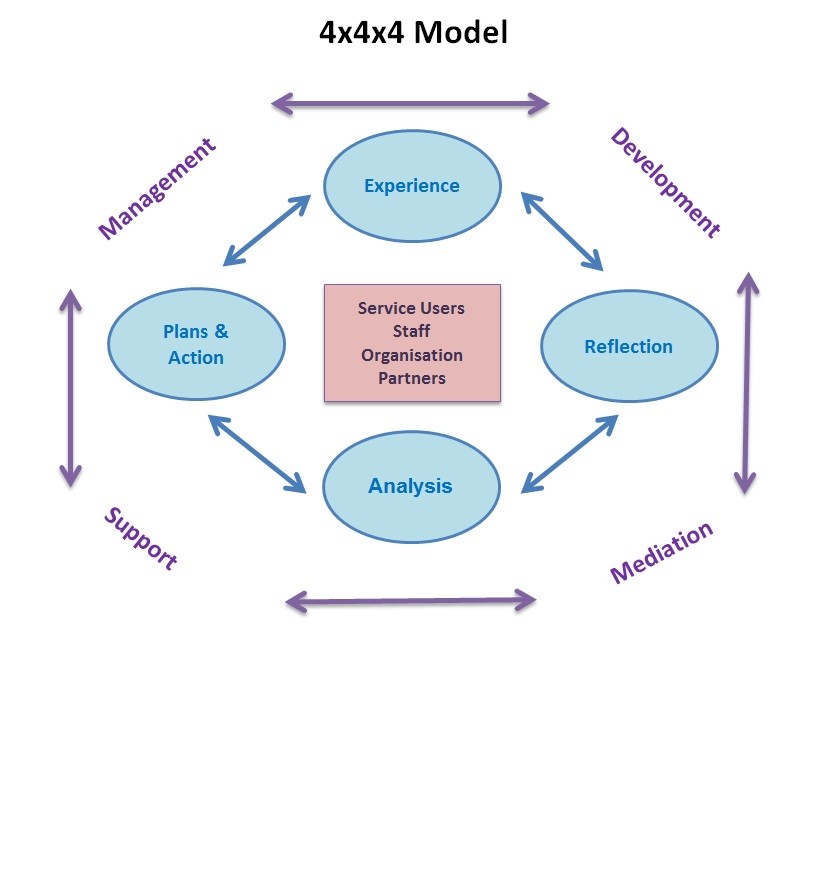
This integrated model of supervision can be used to deliver managerial and professional supervision. Within this model the term ‘management’ is used broadly to refer to the role that any supervisor has (whether they are the supervisee’s line manager, or not) is accountable for the professional advice supervisees are given and any practice decisions which emerge from supervision discussions. This model further acknowledges the interdependence of the four functions of supervision, their impact on key stakeholders and the four stages of the supervision cycle. At the heart of the 4x4x4 model is the principle that supervision is part of intervention with people who use services. It is not an add-on activity but one which is intimately linked with the quality of service and the degree to which the service has a positive impact on those who use it.
As Morrison states:
“The importance of getting the supervision of staff right in social care, and of positive role modelling by managers, cannot be overstated. The quality of services to vulnerable users and the level of staff morale, skills and motivation are all inextricably bound up with the fate of supervision and the degree to which supervisors and managers model the attitudes and behaviours that the organisation wishes its frontline staff to adopt. Put starkly, it is not the existence of supervision per se that makes a difference; what is necessary is good supervision“.
This policy aims to support staff to deliver and contribute to good supervision.
For more information see, The 4x4x4 Supervision Model (Research in Practice)
4. Supervision Procedures
4.1 Supervision agreement
Completing a supervision agreement at the start of the supervisory relationship will help to create a supportive supervision environment, where trust and understanding can develop. The supervision agreement is the foundation for the development of an effective supervisory relationship, as it clarifies the rights and expectations on both sides.
The supervision agreement mirrors the relevant content of this policy.
A new agreement must always be completed at the start of the supervisory relationship i.e. for new staff members and if there is a change of supervisor.
4.2 Frequency and length
The Local Government Association’s (LGA) standard outlines the expected frequency of supervision as follows:
- ensure that supervision takes place regularly and consistently and lasts for an uninterrupted duration of at least an hour and a half;
- make sure that supervision takes place:
- for newly qualified social workers – at least weekly for the first six weeks of employment of a newly qualified social worker, at least fortnightly for the duration of the first six months, and a minimum of monthly supervision thereafter;
- for social workers who have demonstrated capability at ASYE level and above – in line with identified needs, and at least monthly.
In line with this expectation, supervision should ordinarily last between one and a half hours and two hours and should not occur less than monthly, however, it may need to be more frequent to meet the developmental and professional needs of the worker.
It is good practice for supervisors to book supervision in advance and recommended that all supervisions are booked in for the whole year.
4.3 Cancellation
Supervision is a joint responsibility, and both supervisor and supervisee should adhere to the dates that have been arranged. It is recognised that there are some instances where supervision will need to be cancelled. This should only be for the following reasons:
- absence from work due to sickness for either party;
- urgent personal matters for either party;
- urgent case matters which require immediate attention by either or both parties e.g. court appearance;
- emergency/ unforeseen circumstances;
- annual leave.
Rescheduling of the supervision should be done as soon as possible, by whoever has cancelled it, with every effort that it does not fall outside the agreed timescale.
4.4 Location
Supervision should take place in a comfortable and confidential space, whether in person or via Microsoft Teams (preference to be discussed during supervision agreement).
4.5 Supervision agenda
The four functions of supervision mentioned above will be covered in the supervision agenda. This will inform and be informed by the Trafford appraisal process EPIC check in (opens in Trafford Council intranet), which needs to be completed at least every 6 months. Issues discussed in the EPIC check in, will be picked up in monthly supervision in the appropriate area of the agenda.
The template supervision agenda covers the following areas:
- personal support and wellbeing;
- progress on actions from last supervision;
- caseload discussion and summary of actions;
- complex case reflection;
- continuing professional development (CPD);
- any other business.
These areas will encompass the four areas of the 4x4x4 model (Management, Development, Support, Mediation / Engagement with the organisation).
A list of questions to support the use of Kolb’s Learning Cycle and some other resources are outlined in Appendix 4.
4.6 Personal support, wellbeing and CPD
It is important that personal aspects of supervision are given the same priority as case supervision. This is to ensure that the supervisee is being supported with their wellbeing, where workers are given the opportunity to manage anxiety, consider how their own biases and beliefs may be affecting practice, reflect on the dynamic of the interaction between themselves and those using services, whilst additionally using their intellectual capabilities to form professional judgments, decisions and plans.
This aspect of the agenda also encompasses the worker’s career development and progress towards their goals, identified in their 6 monthly EPIC check in. This discussion should include what reading, research, training, feedback or other development activity they have completed since the last supervision and the impact this has had on their practice, with specific examples given. The use of Research in Practice for Adults (RiPFA) should be encouraged and their use of this resource. It is expected that staff will record their learning on the template ‘Continuing Professional Development: Impact on Practice’ (see Appendix 9) after engaging in any CPD activity, whether formal training, reading, shadowing, reflective time etc.
4.7 Case supervision
Formal case supervision should help to evidence what progress is being made on actions agreed at the last supervision, as well as planning future actions for current cases. The supervision will not only enable the supervisor and supervisee to ensure that statutory requirements are being met but also enable the supervisee to reflect on their practice and learn from their experiences to inform future practice and decision making.
Most cases will be discussed in the ‘Case Load Discussion and Summary of Actions’, part of supervision. However, two cases will be discussed in detail every session in the Complex case discussion part of the session. It is expected that the supervisee will have prepared a written reflection for one of these and sent this to their supervisor at least 24 hours before supervision. There is an example of a template based on Kolb’s learning cycle, in Appendix 3, which can be used, however, it is up to the supervisee which reflective tool they use for this written reflection. There are also some prompt questions to support reflective discussion in Appendix 4. These questions may prompt ideas for developing the worker’s practice further, through engagement with relevant research, training of other learning opportunities.
4.8 Ad hoc advice in between supervision sessions
If the supervisee wishes to request ad hoc advice, they should e-mail the supervisor to request his/her availability for an ad hoc supervision session, unless this is an urgent matter, in which case they should strive to contact their supervisor immediately.
4.9 Group supervision
Currently group or peer supervision is arranged on a team-by-team basis depending on the team structure and remit.
4.10 Recording supervision
Recording formal supervision sessions
It is the supervisor’s responsibility for completing the supervision record (Appendix 2).
The supervisor will endeavour to send the supervision record to the supervisee for their agreement within 5 working days. Once this has been agreed, the supervisor will save this on the supervisee’s electronic file. The supervisee should save this record in their own electronic files also.
The supervisee should also make a record of agreed actions or tasks at the time of the supervision, as a record and reminder for their immediate reference.
Recording decision in LAS
It is the supervisee’s responsibility to record any decisions relating to a service user on the LAS case notes within one working day, and to case notify the supervisor, once completed.
Recording decisions from ad hoc discussions
Actions and decisions agreed in ad hoc / informal supervision which occur between formal supervision sessions, will be recorded by the supervisee on the service user’s LAS case notes and the supervisor (or other manager who has given the advice) case notified. It is very important that this occurs, to ensure accountability and a record of advice given and agreed.
4.11 Confidentiality, access, storage and retention
Supervision is a private but not a confidential process. This means that the records are the property of the organisation, not the individual. From time-to-time supervisors will need to discuss the contents of supervision sessions with others where necessary e.g. their own line manager. This should be done on a sensitive basis.
Access to supervision records should be controlled and all records should be stored electronically in a secure location. Individual management teams can create a secure folder on the Trafford network for the purpose of storing confidential supervision documents.
The process on the Trafford Council intranet is as follows: ICT services > Modify a network account > New shared folder > Add detail i.e. secure folder highlighting who will have access (limited to management team etc.) > send to approver
Access to supervision records will only be permitted to the following staff for purposes set out below, these include:
- Senior Managers / Directors – for quality assurance purposes;
- Investigating Officers / HR – for disciplinary or conflict / resolution purposes;
- Inspectors – CQC etc.;
- Performance staff – for administrative support purposes, with clear evidence of confidentiality expected.
Where a member of staff transfers to another section or supervisor within the directorate their records should be passed on to the new supervisor. Where there are ongoing paper records, these should be stored in a locked cabinet and access should be controlled.
4.12 Reviewing supervision and resolving supervision difficulties
The manager of each supervisor is responsible for reviewing and considering on a regular basis the quality and effectiveness of the supervision which is being provided to every social care worker.
Every supervisor should regularly check with their supervisees that the process is meeting their professional needs.
Supervisees who have concerns about whether their supervisory needs are being met should first speak to their supervisor about this within supervision. However, if the issue cannot be resolved after discussion with the supervisor, the supervisee should raise the issue with their supervisor’s line manager to discuss the issues and try to find a resolution.
5. Quality Assurance
The quality assurance of supervision is important to ensure that the supervision in adult services is of good quality. The process by which quality will be checked is as follows:
- the supervisor’s line manager will review a sample of their supervisee’s supervision records (equivalent to 30% of the total number of staff they supervise, e.g. if the supervisor supervises 10 staff, 3 staff records will be audited), at least every 12 months and complete a supervision audit template for each (Appendix 8);
- the audit will involve the auditor (supervisor’s line manager) asking for a self-audit from the supervisor and their supervisees (see Appendix 6 & 7). These will help identify how supervision practice makes a difference to the supervisee and may also involve a 1-2-1 discussion with the supervisee;
- the feedback from supervisees can be used to identify themes, strengths and any areas for improvement, which can then be discussed between the supervisor and the auditor, as part of the audit process and contribute to the collation of learning for organisational improvement;
- where permission is given, the findings of each self-audit will be shared to inform the supervisor and supervisee of each other’s views;
- where permission is not given, the auditor shall request the supervisor provide evidence to allow reflection and discussion around the themes that have been elicited from the self-assessment information and the answers given will inform the overall audit;
- the audit will monitor all aspects of supervision, as outlined in this policy and will result in remedial actions, where supervision is found to be falling beneath the required standard.
6. Learning and Development of Supervisors
It is intended that supervisors of social workers will meet the Post-qualifying Standards for Social Work Practice Supervisors in Adult Social Care.
Supervisors will be supported to evidence their supervisory practice using the Practice Supervisors Knowledge and Skills Statement evaluation template (Appendix 10).
New supervisors of social workers will be supported and assessed while completing the Post-qualifying Standards for Social Work Practice Supervisors in Adult Social Care Development Pathway which involves the completion of a portfolio following suitable training and development opportunities.
7. References / Further Reading
Knowledge and Skills Statement for social workers in adult services (gov.uk)
Professional Standards (Social Work England)
Standards for Employers of Social Workers in England (Local Government Association)
Morrison, T. (2005) Staff Supervision in Social Care
8. Appendices
The following can be provided upon request:
- Appendix 1 Supervision Agreement
- Appendix 2 Supervision record template
- Appendix 3 Case reflection template
- Appendix 4 Resources to support supervision
- Appendix 5 Record of dates of supervision
- Appendix 6 Supervision self-audit by supervisee
- Appendix 7 Supervision self-audit by supervisor
- Appendix 8 Supervision audit